
Course Includes:
- 💰 Price Free
- 👥 Students 28,500
- 📚 Lessons 48 Lessons
- ⭐ Review 4.7 (1234)
IB Psychology 2027 Curriculum Model
-
28 Jul. 2026
The DP Psychology curriculum encompasses psychological literacy by integrating concepts, content, and contexts to help students critically understand and apply psychological knowledge to real-world behaviour.
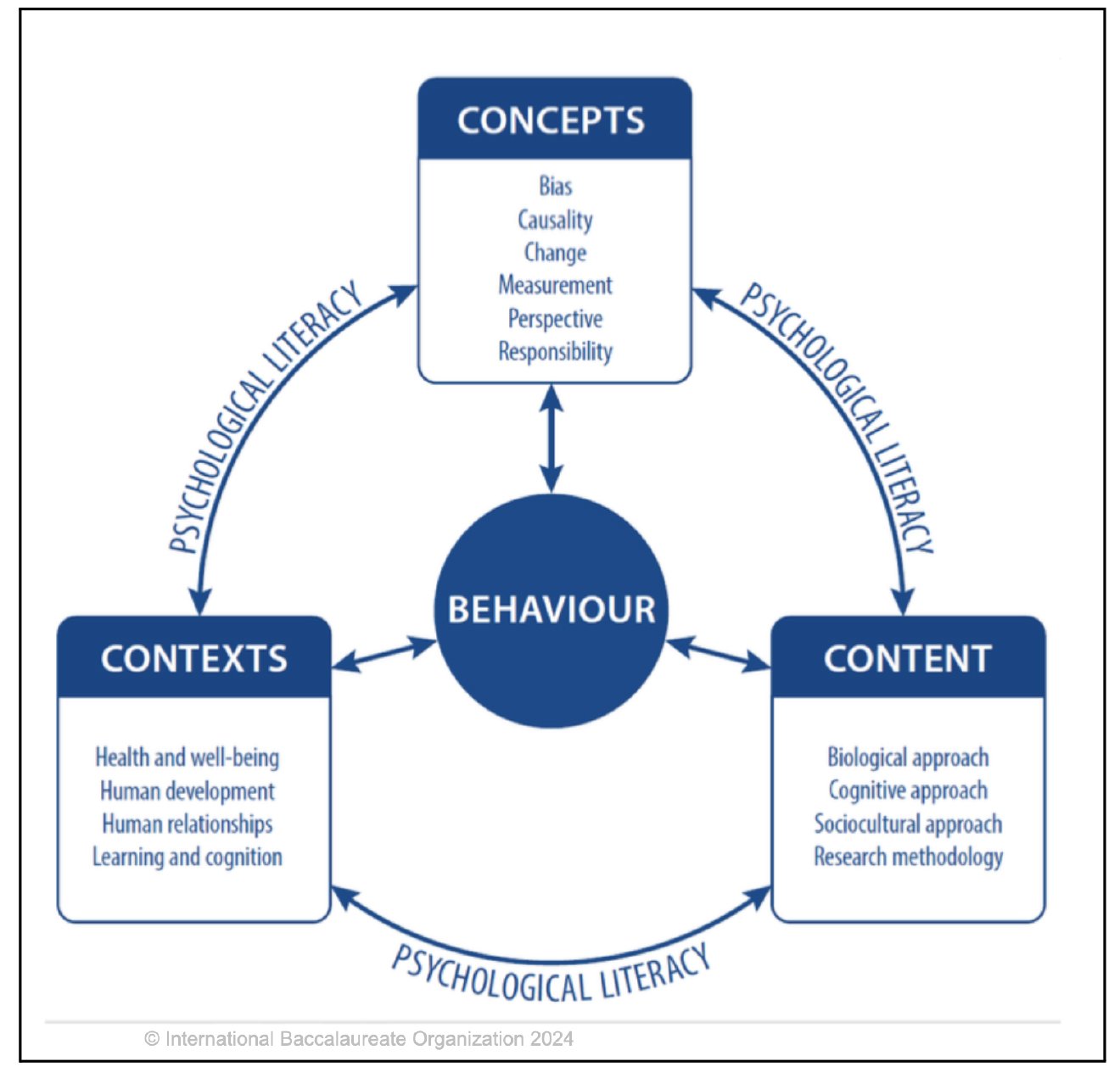
In IBDP Psychology, concepts are not isolated definitions to memorize mechanically. They are broad abstract ideas that help psychologists think critically about human behaviour, research, and explanation. Concepts function like intellectual lenses through which psychological theories, studies, methods, and arguments are interpreted. They help students move beyond simply describing studies toward understanding the deeper assumptions, limitations, implications, and applications of psychology in real life. This is why concepts are considered the “big ideas” of psychology: they allow psychological thinking to be transferred across different contexts in interpreting behaviour.
concepts, content, and contexts.
These three pillars constantly interact rather than functioning separately.
The first pillar is content, which refers to the actual psychological knowledge students study. This includes theories, studies, models, explanations, brain processes, cognitive mechanisms, social influences, developmental theories, health behaviours, and research methods. The content provides the factual and theoretical foundation of psychology.
The second pillar is contexts. IB Psychology organizes behaviour into four major
contexts:
- health and well-being,
- human development,
- human relationships,
- and learning and cognition.
These contexts represent major domains of human experience where psychological processes operate. They help students understand that psychology is not merely theoretical knowledge inside textbooks; it is the study of how biological, cognitive, emotional, and sociocultural factors shape real human behaviour across life situations.
Within each context, students examine behaviour through three major psychological approaches:
● the biological approach, which explains behaviour through brain systems, genetics, hormones, neurotransmitters, evolution, and physiology;
● the cognitive approach, which explains behaviour through mental processes such as thinking, memory, schemas, perception, decision-making, and information
processing;
● and the sociocultural approach, which explains behaviour through culture, relationships, social norms, group processes, language, and environmental influences.
This structure is extremely important because it prevents reductionism. Human behaviour is rarely explained fully by one approach alone. For example, depression may involve neurotransmitters biologically, negative thinking cognitively, and social isolation socioculturally. IB Psychology therefore teaches students to see behaviour as multidimensional and interacting rather than caused by one single factor.
The third pillar is concepts, which provide the critical thinking framework for evaluating and applying psychological knowledge. Concepts help students ask deeper
questions such as:
● How reliable is this explanation?
● Could cultural bias affect this study?
● Does correlation prove causation?
● How was behaviour measured?
● Can behaviour change?
● Which perspective is shaping this explanation?
● What ethical responsibilities do psychologists have?
bias, causality, change, measurement, perspective, and responsibility.
These concepts are woven throughout every topic rather than studied separately. For example, when studying attachment:
● discussing whether parenting causes attachment style involves causality,
● discussing cultural differences in caregiving involves perspective,
● discussing laboratory methods such as the Strange Situation involves measurement,
● discussing self-report limitations involves bias,
● discussing whether insecure attachment can later change involves change,
● and discussing Harlow’s monkey studies involves responsibility.
This integration is one of the deepest features of IB Psychology because it teaches students not only to know psychology but to think psychologically.
The curriculum also emphasizes research methodology across all contexts.
Psychologists cannot directly see thoughts, memories, emotions, attachment, intelligence, or beliefs, so they must operationalize invisible mental processes into measurable forms using experiments, interviews, questionnaires, observations, brain imaging, psychometric tests, and longitudinal studies. IB Psychology therefore teaches students not only psychological findings but also how psychological knowledge itself is constructed, measured, interpreted, and evaluated.
The deepest philosophical idea behind the DP Psychology curriculum is that psychological knowledge is never completely absolute. Human behaviour is extraordinarily complex because it emerges from interacting biological systems, mental processes, emotions, experiences, relationships, cultures, environments, and personal interpretations. The curriculum therefore trains students to tolerate complexity, think critically, compare perspectives, evaluate evidence, and apply psychological understanding to unfamiliar situations rather than memorizing isolated facts mechanically
Bias refers to systematic influences that distort objectivity, interpretation, sampling, measurement, or conclusions in psychology. Bias can come from researchers, participants, culture, methods, expectations, publication systems, or social assumptions.
The deepest idea is that psychologists attempt objectivity but must constantly recognize that complete neutrality is difficult because human interpretation itself is shaped by perspective, culture, expectation, and methodology.
Causality refers to understanding cause-and-effect relationships in behaviour.
Psychology tries to identify what causes behaviour through experiments and controlled research. However, human behaviour is rarely caused by one simple variable alone. Most behaviour emerges from interacting biological, cognitive, emotional, environmental, and sociocultural systems. This is why modern psychology increasingly recognizes feedback loops, bidirectional influence, domino causality, and dynamic systems rather than simple linear causes. Domino causality means one factor triggers another factor, which then triggers another, creating a chain reaction of causes and effects — like falling dominoes hitting each other one after another.
In psychology, behaviour is often not caused by one direct event alone. Instead, one experience starts a sequence of psychological, emotional, biological, or social changes that gradually influence behaviour over time.
For example, imagine a child experiencing chronic bullying at school.
The bullying may first cause stress and social fear.
That stress may lower self-esteem and increase cortisol levels.
Low self-esteem may lead the child to withdraw socially.
Social withdrawal may reduce friendships and emotional support.
Reduced support may increase loneliness and depression.
Depression may then affect academic performance and motivation.
So the final behaviour was not caused by one single event directly. The original experience triggered a chain of connected effects, where each factor influenced the next
— just like falling dominoes
The powerful idea behind domino causality is that:
human behaviour often develops through interacting sequences rather than one simple isolated cause.
Change refers to the possibility of altering behaviour, cognition, emotion, mental health, relationships, or developmental pathways over time. Psychology studies how change happens, what prevents change, and how interventions can improve well-being. Change can occur biologically through neuroplasticity, cognitively through learning and schema modification, emotionally through relationships and therapy, or socially through culture and environment. The deepest idea is that humans are neither completely fixed nor infinitely flexible.
Measurement refers to how psychologists operationalize invisible psychological processes into observable and measurable forms. Since thoughts, emotions, attachment, intelligence, memory, or self-esteem cannot be directly be seen, psychologists use tools such as experiments, questionnaires, psychometric tests, observations, interviews, brain imaging, and behavioural tasks. Every measurement method has strengths, limitations, reliability issues, validity concerns, and potential biases.
Perspective refers to the different approaches psychologists use to explain behaviour. No single perspective explains behaviour completely. Biological perspectives focus on brain systems, genetics, hormones, and evolution. Cognitive perspectives focus on mental processes such as thinking, memory, schemas, and decision-making. Sociocultural perspectives focus on culture, relationships, social norms, and environmental influences.
The deepest insight is that human behaviour is multidimensional, and different perspectives emphasize different levels of explanation.
Responsibility refers to the ethical and social obligations psychologists have toward participants, clients, society, and the interpretation of research itself. This includes minimizing harm, obtaining informed consent, protecting confidentiality, avoiding stigma, evaluating social consequences, and balancing scientific benefit against potential damage. Responsibility also extends beyond experiments into therapy, education, public policy, and how psychological knowledge influences society.
The strongest IB Psychology answers do not merely define these concepts separately. They weave them naturally into explanations, studies, evaluations, and arguments. For example:
● discussing how a study measures attachment involves measurement,
● discussing whether parenting causes attachment style involves causality,
● discussing cultural differences in parenting involves perspective,
● discussing self-report limitations involves bias,
● discussing therapy or developmental change involves change,
● and discussing ethical concerns or stigma involves responsibility.
Why behaviour at the center
Behaviour is placed at the centre because the entire IB Psychology curriculum ultimately revolves around understanding, explaining, predicting, and influencing human behaviour. Everything else in the model — concepts, content, and contexts — exists to help psychologists understand why humans think, feel, and behave the way they do.
The content gives explanations for behaviour.
The biological approach explains behaviour through the brain, hormones, neurotransmitters, and genetics.
The cognitive approach explains behaviour through thinking, memory, perception, schemas, and decision-making.
The sociocultural approach explains behaviour through culture, relationships, social norms, and environment.
Research methodology helps psychologists scientifically investigate behaviour.
The contexts show where behaviour occurs in real life.
Health and well-being studies health-related behaviour and mental health.
Human development studies behavioural changes across life.
Human relationships studies social interaction and group behaviour.
Learning and cognition studies how behaviour is shaped through thinking, memory, and learning.
The concepts help psychologists think critically about behaviour.
Bias asks whether behaviour or research interpretation is distorted.
Causality asks what causes behaviour.
Change asks whether behaviour can be modified.
Measurement asks how behaviour can be scientifically studied.
Perspective asks which explanation is being used to interpret behaviour.
Responsibility asks how behaviour research and psychological knowledge should ethically be applied.
So behaviour is at the centre because psychology is fundamentally the scientific study of behaviour and mental processes. The entire curriculum constantly connects back to understanding human behaviour from different lenses, methods, and real-world contexts.
The IB Psychology curriculum encompasses psychological literacy
Psychological literacy revolves around the entire curriculum because the ultimate goal of psychology is not merely to memorize theories or studies, but to apply psychological understanding critically, ethically, and meaningfully to real human behaviour and real-world situations. It connects concepts, content, and contexts together so that students learn how to think psychologically about themselves, others, society, decision-making, relationships, mental health, and behaviour beyond the classroom.
Assessment
The IB Psychology assessment consists of two major components: external assessment and internal assessment.
The external assessment is made up of three examination papers. For Standard Level (SL) students, Paper 1 and Paper 2 are each worth 35% of the final grade. For Higher Level (HL) students, Paper 1 and Paper 2 are each worth 25% of the final grade, while Paper 3, which is completed only by HL students, is worth 30% of the final grade. Papers 1 and 2 are identical for both SL and HL students.
The internal assessment (IA) is a research proposal based on psychological research methods. It is designed to take approximately 20 hours to complete and is assessed out of 24 marks. The IA contributes 30% of the final SL grade and 20% of the final HL grade.
Paper 1: Integration of Concepts, Content, and Contexts
Paper 1 assesses students’ ability to integrate psychological concepts, theories, studies, and real-world contexts across the course.
Section A consists of two compulsory short-answer questions. Each question comes from one of the three approaches in psychology: the biological approach, cognitive approach, or sociocultural approach. Students are required to describe or explain a specific content point and support their answer with an example. The example may come from a psychological study or from a real-life situation relevant to the topic.
Section B consists of two compulsory short-answer questions based on unseen scenarios. These questions require students to apply their psychological knowledge to new situations linked to one of the four contexts in the course. The emphasis is on applying concepts and theories rather than simply recalling information.
Section C is the extended response or essay section of the examination. Students choose one out of two essay questions. Each essay question combines three elements: a context, a concept, and a content point.
For example, a question may ask: “One claim in Health and Wellbeing Psychology is that one perspective is not enough to explain mental health. Discuss this claim with reference to one biological explanation of one or more disorders.”
In this example: the context is Health and Wellbeing, the concept is Perspective, and the content point is the biological explanation of disorders.
Students must integrate all three components while constructing a balanced and well-supported argument.
Paper 2: Applying Concepts and Content to Research Contexts
Paper 2 focuses on research methods and conceptual analysis within psychological research.
Section A is based on the four class practicals completed during the course: an experiment, an observation, a survey/questionnaire, and an interview. Students answer four structured questions about these practicals to demonstrate understanding of research methods, methodology, concepts, and procedural design.
Section B presents students with an unseen research study. The study may be fictional or may be a study unfamiliar to students and not included in textbooks. Students must discuss the study using two or more concepts selected from: bias, causality, measurement, and responsibility. The exam may provide anywhere between two and six concepts to choose from. Students are expected to critically analyze the research design, methodology, ethical considerations, and interpretation of findings using these conceptual lenses.
Paper 3 (HL Only): Data Analysis and Interpretation
Paper 3 is completed only by Higher Level students and focuses on data analysis, interpretation, and evaluation of research evidence.
The paper is document-based and built around one of the three HL extension topics: motivation, technology, or culture. These extension topics are linked to one of the four course contexts: cognition and learning, health and wellbeing, human development, or human relationships.
Students are provided with four separate research findings related to a central claim. The paper includes two quantitative findings and two qualitative findings. One quantitative finding is usually presented as graphed data, while the other includes a data set with statistical calculations. The qualitative findings involve descriptive or interpretive research evidence.
There are four semi-static questions in Paper 3. They are called semi-static because the structure and style of the questions remain predictable, but the actual research findings, data, and claims provided in the exam are unseen. The final question is an evaluative mini-essay in which students must discuss the extent to which the central claim is supported by the four research findings as well as their own psychological knowledge and understanding of the topic. This paper therefore assesses students’ ability to interpret research evidence, integrate multiple sources of data, evaluate claims critically, and construct evidence-based arguments.
Internal Assessment (IA)
The Internal Assessment is a research proposal in which students design a psychological investigation involving a population of interest using one of the four research methods studied during the class practicals.
The IA assesses students’ understanding of research methodology, ethical considerations, procedural design, operationalization, and application of psychological theory within a research context.
Students first produce a rough draft and receive teacher feedback to improve the proposal. The teacher then assesses the final version internally within the school.
For moderation purposes, the school uploads selected samples of student work to the IB. An external moderator reviews these samples to determine whether the teacher’s marking aligns with IB assessment standards. If necessary, marks for the entire cohort may be adjusted to ensure consistency and fairness across schools internationally.
The maximum word count for the Internal Assessment is 2200 words, excluding references and appendices.