IB Core-TOK, Extended Essay, CAS
TOK Essay: May 2027 Prescribed Titles
How to Write a TOK Essay: May 2027 Prescribed Titles
A strong IB Theory of Knowledge essay is not a collection of interesting examples followed by a conclusion. It is a controlled argumentative journey in which an initial position is repeatedly tested, refined and ultimately justified. The complete TOK argumentative spine can therefore be understood as Hook (open with the tension, contradiction, anomaly or unresolved problem that makes the inquiry necessary) → Context (give the background needed to understand why the issue matters and what is at stake) → Interpret the Question (identify the command or stem, clarify concepts, establish boundaries and expose assumptions) → Thesis (answer directly through a central position, principal reasoning and decisive conditions) → Line of Argument (identify the connected reasons through which the thesis will be established) → Claim (develop one focused reason derived from the thesis) → Evidence (provide specific, relevant and credible support) → Analysis (explain how and why the evidence supports the claim and why that relationship matters) → Counterclaim (introduce the strongest alternative explanation, objection, exception, limitation, missing perspective or challenging condition) → Counter-evidence or Reasoning (show why the challenge deserves serious consideration) → Evaluation (weigh the claim and counterclaim through appropriate criteria) → Response (refute, concede, qualify or integrate the challenge) → Refined Claim (state what remains responsibly defensible after scrutiny) → Link to Thesis (show how the refined claim strengthens the central position) → Further Argument Cycles (develop as many distinct and necessary claims as the title and word limit permit) → Synthesis (connect the refined findings and reveal what they mean together) → Reinforced Thesis (return to the original position with greater precision) → Qualified Final Judgement (specify the justified degree, conditions, boundaries or exceptions) → Implication (explain why the judgement matters or what it changes). This architecture matters because a TOK thesis should not remain frozen from introduction to conclusion: claims support it, counterclaims pressure-test it, evaluation refines it, and synthesis allows the final judgement to become more precise than the position with which the essay began.
The IB currently describes TOK as an inquiry into the nature of knowledge and how we know what we claim to know, with assessment including a 1,600-word essay. That limited word count is exactly why architecture matters: students cannot afford paragraphs that contain information but perform no argumentative function.
TOK Command Terms and Question Stems in the May 2027 Prescribed Titles
The May 2027 TOK prescribed titles use a small but demanding set of command terms and question stems that determine exactly what kind of reasoning the essay must perform. “Discuss”, appearing across several titles, requires the learner to examine credible competing positions, test them through evidence and counter-evidence, and move towards a justified rather than artificially balanced judgement. “Do we…?” in Title 1 may look like a yes-or-no question, but it requires the proposition to be tested conditionally, while the “artist or historian” construction demands comparison through explicit criteria—particularly what is meant by a “better appreciation.” Titles 2 and 3 use “how can…?”, which asks for the mechanism or conditions through which an apparent difficulty can be resolved: in Title 2, “If…nevertheless” deliberately creates a tension between changing values and their continuing ability to guide knowledge, while Title 3 asks how reliability can remain possible despite knowledge being built on assumptions. Titles 4 and 5 use “to what extent”, requiring a calibrated judgement of degree rather than simple agreement or disagreement: the essay must establish where the proposition holds strongly, where it weakens, and what conditions determine its limits. Title 4 further asks “to what extent do you agree”, making the quoted claim itself the object of scrutiny, while Title 5 combines “when”, “to what extent” and “should”: when asks under what conditions one explanation is chosen over another, to what extent asks how much weight simplicity deserves, and should requires a normative judgement about whether that priority is epistemically justified. Title 6 asks “what value is there…?”, so the writer must first establish criteria for value and then judge what exploring the paradoxical or counterintuitive contributes to the pursuit of knowledge, as well as where that contribution becomes limited. Finally, “with reference to…” is not an invitation to write separate mini-essays on different Areas of Knowledge; the specified AOKs must be used comparatively to reveal how the same knowledge problem changes across different methods, standards of evidence, assumptions and forms of justification. In every title, therefore, the wording is not introductory decoration: the question stem determines the shape of the thesis, the movement of the argument and the kind of qualified judgement the conclusion must ultimately deliver.
May 2027 TOK Prescribed Titles: How to Build the Argument
TOK Title 1: Do we gain a better appreciation of the human experience from the artist or the historian? Discuss with reference to the arts and history.
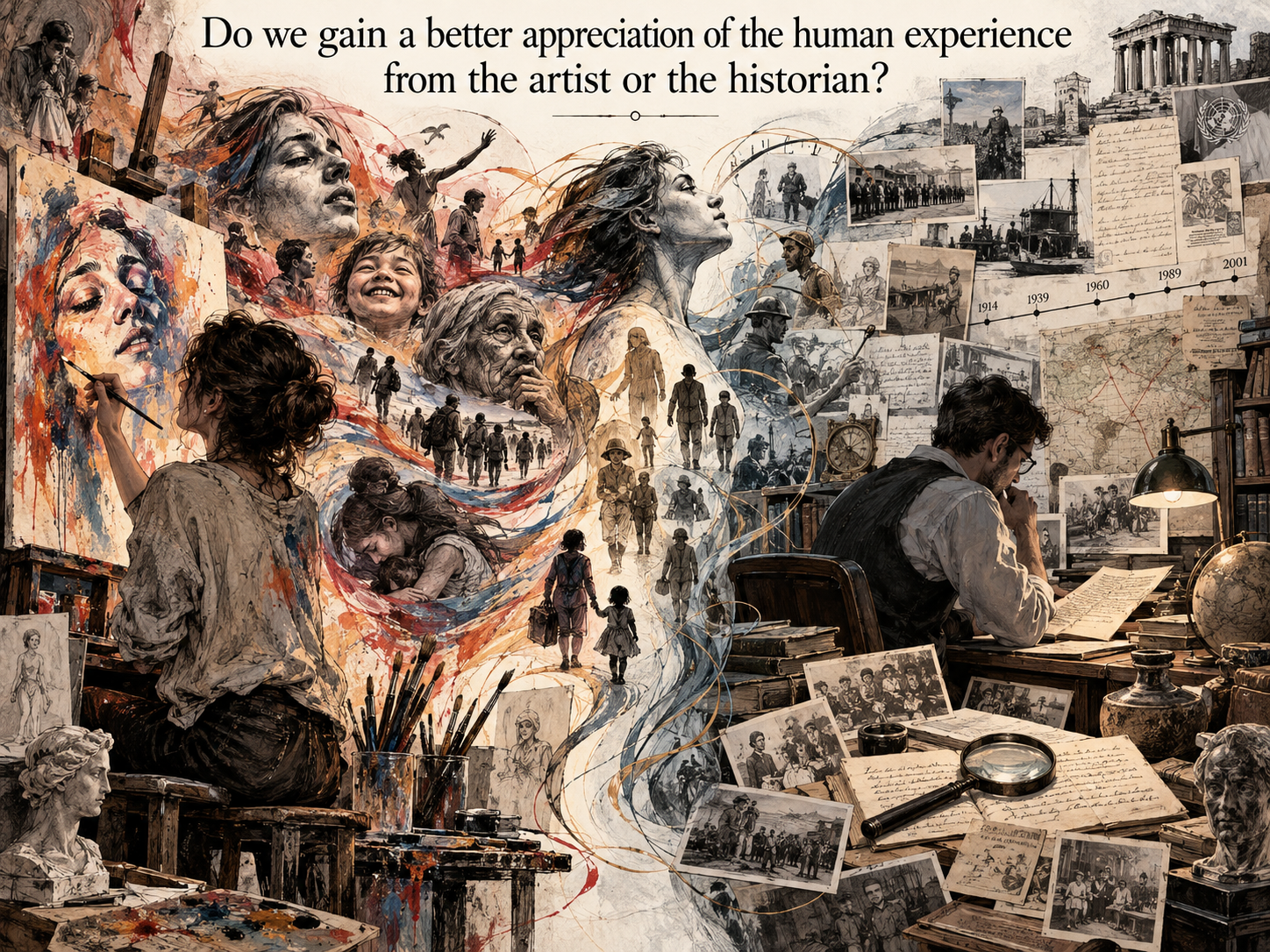
What is the Real Knowledge Problem?
The title is not really asking “Who is better: artists or historians?” The intellectual pressure sits inside “better appreciation” and “human experience.” Does appreciation mean knowing accurately what happened, understanding why it happened, recognising how it felt, encountering an individual perspective, or understanding the larger social conditions surrounding that experience? Until the writer establishes criteria for better, there can be no meaningful comparison.
Possible Hook
History can tell us that people disappeared; art can make absence itself confront us. But does feeling the weight of an experience mean that we understand it better?
Thesis Direction
A defensible direction would be that neither artist nor historian has an automatic advantage. Artists may provide greater access to the subjective, emotional and embodied dimensions of human experience, while historians may produce a more evidentially accountable understanding of its causes, contexts and representativeness. “Better” therefore depends on which dimension of appreciation is being sought.
AOK 1: The Arts
Claim: Artistic knowledge can make otherwise inaccessible dimensions of human experience perceptible.
A striking evidence route is Colombian artist Doris Salcedo’s Noviembre 6 y 7. In 2002 she lowered 280 empty wooden chairs down the façade of Bogotá’s Palace of Justice, the site of the violent 1985 siege. The work unfolded over approximately the same duration as the original event.
Do not use this merely to say “art creates emotion.” Push it further. The empty chair converts an historical absence into a physical encounter. The historian may establish casualties, chronology and responsibility; Salcedo makes absence itself an object of knowledge. The direction of argument is therefore:
subjectivity → embodied encounter → emotional knowledge → appreciation of lived experience.
Activate subjectivity, perspective, interpretation and culture.
Counterclaim: Artistic intensity can create powerful appreciation while simultaneously creating a false understanding.
Use D. W. Griffith’s The Birth of a Nation (1915) precisely because it is uncomfortable. The film was technically innovative and emotionally compelling, yet the Library of Congress describes its depiction of Reconstruction as historically skewed and notes that it enshrined racist stereotypes while portraying the Ku Klux Klan heroically.
This produces a far more interesting counterclaim than “artists are biased.” The very artistic capacities that make experience vivid—narrative, identification, selective representation and emotional immersion—can also make distortion extraordinarily persuasive.
Refined Arts Claim
Art may produce unusually deep experiential appreciation, but emotional force cannot itself establish historical reliability. Artistic interpretation becomes epistemically strongest when the knower remains conscious that felt authenticity and factual accuracy are different achievements.
AOK 2: History
Claim: Historians can recover individual human experience while embedding it within evidential context.
An excellent evidence direction is the Federal Writers’ Project Slave Narratives, containing more than 2,300 first-person accounts of slavery and 500 photographs of formerly enslaved people, collected during the 1930s.
The epistemic power here is that history need not reduce human lives to statistics. Testimony allows the historian to reconstruct family relationships, labour, violence, survival and memory while comparing individual accounts against other evidence.
The direction becomes:
testimony → corroboration → contextualisation → historically justified appreciation.
Activate evidence, perspective, interpretation and justification.
Counterclaim: Historical evidence does not give transparent access to experience merely because the witness actually lived it.
Now turn the same archive against the claim. The Library of Congress warns that more than seventy years separated emancipation from many interviews, that most interviewers were white, and that racial power relations could influence what formerly enslaved interviewees were willing to say. One comparison found noticeably different responses depending upon the interviewer’s race.
That is excellent TOK because the evidence has not changed—the epistemic reading of the evidence has.
Historical testimony is therefore simultaneously a window onto experience and evidence of the conditions under which experience becomes recorded.
Synthesis Direction
The artist may make the knower feel what archives cannot fully preserve, while the historian may reveal why the representation should or should not be trusted. The most sophisticated judgement might therefore distinguish depth of experience from reliability of reconstruction, rather than awarding either AOK an unconditional victory.
TOK concepts worth activating: Evidence, Interpretation, Perspective, Subjectivity, Objectivity, Justification, Culture.
TOK Title 2: If values change over time, how can they, nevertheless, continue to guide the pursuit of knowledge? Discuss with reference to two areas of knowledge.
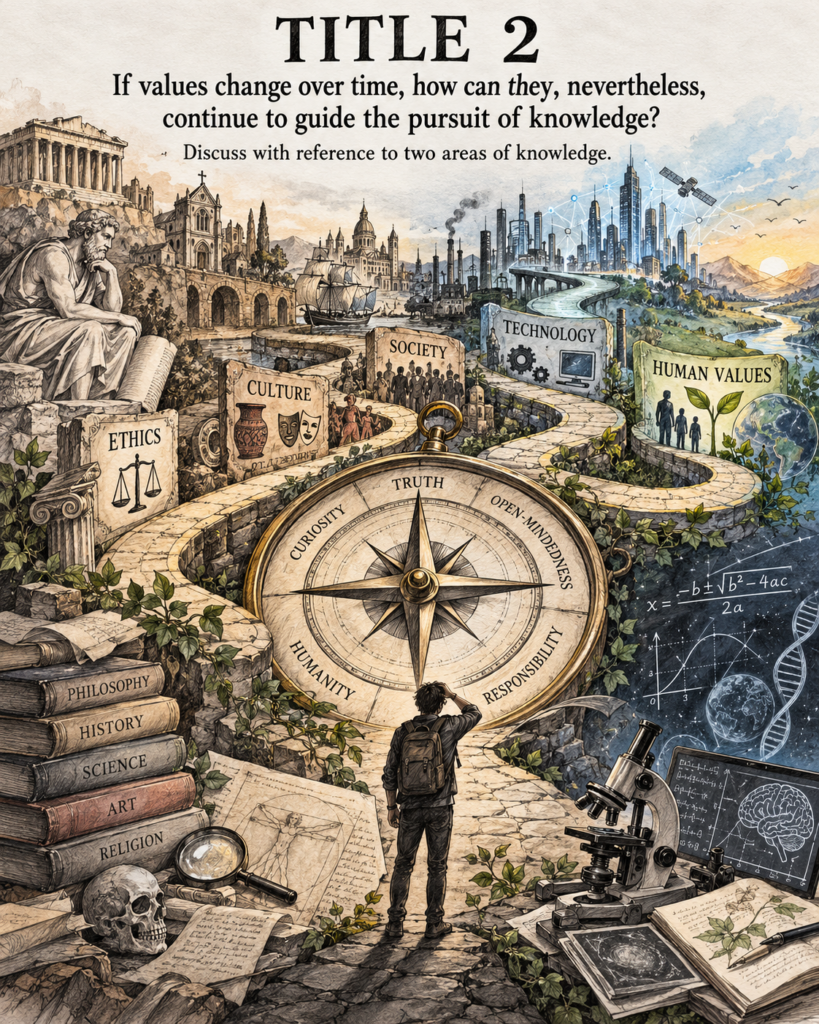
What is the Real Knowledge Problem?
The word doing the intellectual work is “nevertheless.” If values are revisable, culturally situated and historically changing, how can they provide guidance without making the pursuit of knowledge arbitrary?
Possible Hook
A compass whose needle moves would seem useless—unless its ability to move is precisely what allows it to remain responsive to a changing landscape.
Thesis Direction
Values can continue to guide knowledge not because they provide permanent truths, but because they determine responsibilities, priorities and boundaries that can themselves be subjected to criticism and revision. Their legitimate role is strongest in governing how knowledge ought to be pursued, and weaker when values are allowed to decide what the evidence must conclude.
AOK 1: Natural Sciences
Claim: Changing values can improve knowledge by making ethical guidance responsive rather than permanently fixed.
Use the remarkable history of the 14-day rule for human embryo research.
For decades, embryo research operated around a 14-day developmental boundary. Scientific advances eventually made longer in-vitro culture conceivable. In its 2021 revision, the International Society for Stem Cell Research moved beyond treating 14 days as an absolute scientific-ethical prohibition and allowed the possibility of specialised case-by-case review, public discussion and justification where jurisdictions permit it.
The direction is excellent:
value changes do not necessarily destroy guidance → they may convert rigid prohibition into accountable, revisable oversight.
Thus, a value can guide precisely because it is responsive to new knowledge.
Activate values, justification, power and responsibility.
Counterclaim: If values are culturally variable, whose values get to govern scientific inquiry?
The Havasupai blood-sample case provides a sharp challenge. Blood originally collected in research concerning diabetes was subsequently used for studies involving other questions, including schizophrenia and population migration, generating a dispute over consent and cultural meaning. Arizona State University settled claims in 2010 and returned samples.
This is not merely an “ethics example.” It asks whether the scientific value of future research access can override a community’s values concerning identity, ancestry and use of biological material.
Refined Natural Sciences Claim
Changing values can continue to guide science if they operate through transparent, revisable procedures for consent, harm and responsibility, rather than being treated as timeless moral facts.
AOK 2: Human Sciences
Claim: Changes in values can expose assumptions that earlier knowledge communities mistook for objective science.
Use Evelyn Hooker’s 1957 research. Hooker compared 30 homosexual and 30 heterosexual men matched for age, IQ and education; expert judges who were unaware of participants’ sexuality could not reliably distinguish the groups’ psychological adjustment. The research contributed to a larger evidential shift preceding the American Psychiatric Association’s removal of homosexuality from the DSM in 1973.
The deeper TOK route is not:
Society became tolerant, therefore psychology improved.
It is:
changing values made it possible to question whether an apparently scientific category had incorporated an unexamined normative judgement.
Values can therefore generate new questions about old “knowledge.”
Counterclaim: Values can guide inquiry so strongly that prejudice becomes disguised as knowledge.
Use physician Samuel Cartwright’s 1851 “drapetomania”, in which the desire of enslaved people to escape slavery was pathologised as a supposed mental disorder. Contemporary documentation explicitly described “running away” as the diagnostic symptom.
This is devastating evidence because it demonstrates that values can enter not only the application of knowledge but the creation of the categories through which phenomena are observed.
Synthesis Direction
The question is therefore not whether values should disappear. They cannot. The stronger issue is whether knowledge communities possess mechanisms for distinguishing values that expose epistemic blind spots from values that manufacture them.
TOK concepts: Values, Culture, Power, Objectivity, Perspective, Justification, Evidence.
TOK Title 3: In the production of knowledge, how can knowledge be reliable if it is built on assumptions? Discuss with reference to the human sciences and one other area of knowledge.
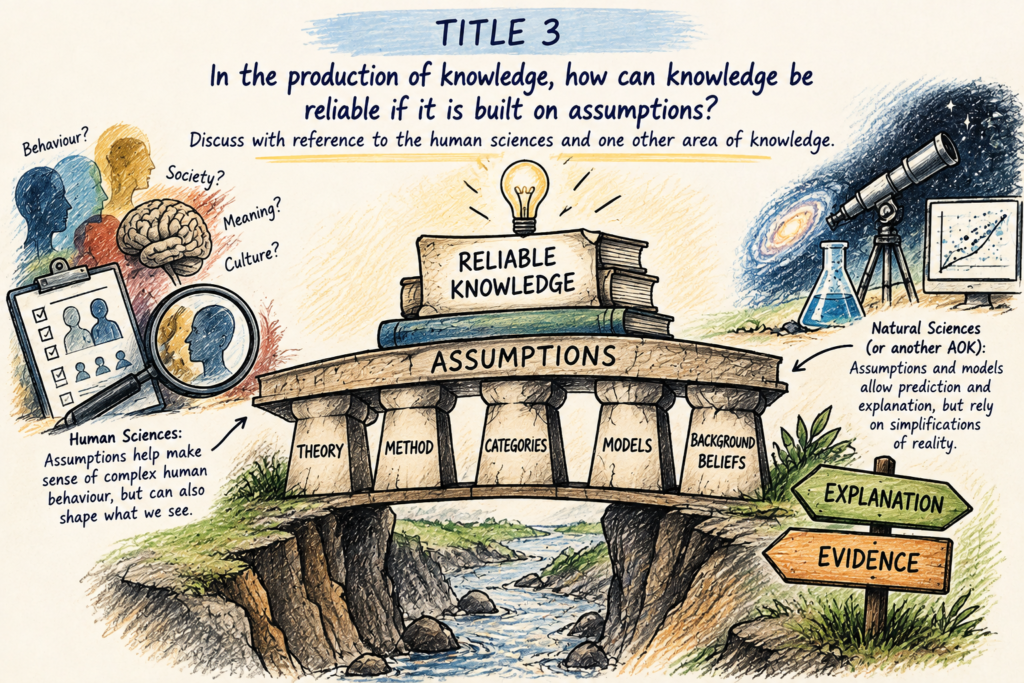
What Is the Real Knowledge Problem?
Do not define an assumption as merely an “unsupported guess.” Knowledge frequently requires assumptions because researchers cannot observe every variable, construct every counterfactual or obtain completely theory-free data.
The better question is:
What transforms an assumption from an epistemic weakness into a legitimate working condition?
Possible Hook
Some of our most reliable knowledge depends upon things we can never directly observe—including what would have happened if an event had never occurred.
Thesis Direction
Knowledge can remain reliable when assumptions are explicit, limited in scope, independently testable where possible and exposed to sensitivity checks or alternative methods. Reliability fails not because assumptions exist, but when their influence becomes invisible or insulated from challenge.
AOK 1: Human Sciences
Claim: Assumptions can make causal knowledge possible when their consequences are openly tested.
Use the synthetic-control study of California’s Proposition 99 tobacco-control programme by Abadie, Diamond and Hainmueller.
Researchers could never observe California simultaneously with and without Proposition 99. They therefore constructed a “synthetic California” from weighted combinations of other states to estimate the missing counterfactual. Their analysis estimated that by 2000 annual cigarette sales were approximately 26 packs per capita lower than the estimated no-policy counterfactual.
This is a superb assumptions example because the central comparison literally does not exist in reality.
Use it to argue:
assumption → modelled counterfactual → observable pre-intervention fit → inferential testing → qualified causal knowledge.
Reliability comes from making the assumption auditable, not from pretending it is absent.
Counterclaim: Hidden analytical assumptions can manufacture apparently robust knowledge.
Use Reinhart and Rogoff’s public-debt research and the replication by Thomas Herndon, Michael Ash and Robert Pollin. The replication identified coding errors, selective data exclusion and unconventional weighting; for economies with debt above 90% of GDP, their recalculation produced average growth of approximately 2.2% rather than −0.1%.
Do not reduce this to “someone made an Excel mistake.” The TOK issue is more interesting: decisions about inclusion, weighting and categorisation can function as hidden assumptions while producing a numerical result that appears objective.
Refined Human Sciences Claim
Reliability is possible when assumptions are visible enough to be challenged and knowledge is reproducible enough for those challenges to matter.
AOK 2: Natural Sciences
Claim: Even technologically produced observations can be assumption-dependent without becoming unreliable.
Use the Event Horizon Telescope’s 2019 image of M87*.
The telescope did not simply take a conventional photograph. Sparse interferometric data had to be reconstructed using imaging algorithms. To test whether assumptions in those algorithms were creating the famous ring, four teams worked independently, different imaging methods were employed, and reconstructions were tested against synthetic data with known “ground truth.” The major ring features remained stable across methods.
This gives students an outstanding argument:
reliability can arise through convergence across different assumption-dependent routes.
Activate objectivity, evidence, certainty and justification.
Counterclaim: Assumptions can become dangerous when an exciting interpretation determines how ambiguous evidence is read.
Use the GFAJ-1 “arsenic life” case. A 2010 claim suggested that a Mono Lake bacterium could incorporate arsenic in place of phosphorus into biological molecules. Subsequent work found no detectable covalently bound arsenate in its DNA and concluded that the organism remained phosphate-dependent.
The valuable direction is:
the evidence was not simply “wrong”; assumptions about contamination, purification and what growth implied shaped the interpretation.
Synthesis Direction
Reliable knowledge is not assumption-free knowledge. It may be better understood as knowledge whose assumptions are sufficiently exposed, bounded, challenged and triangulated that conclusions no longer depend upon one fragile route.
TOK concepts: Reliability through Evidence, Objectivity, Certainty, Justification, Interpretation and Explanation.
TOK Title 4: To what extent do you agree with the claim that “any coincidence is worth noticing; you can throw it away later if it is only a coincidence”? Answer with reference to mathematics and one other area of knowledge.
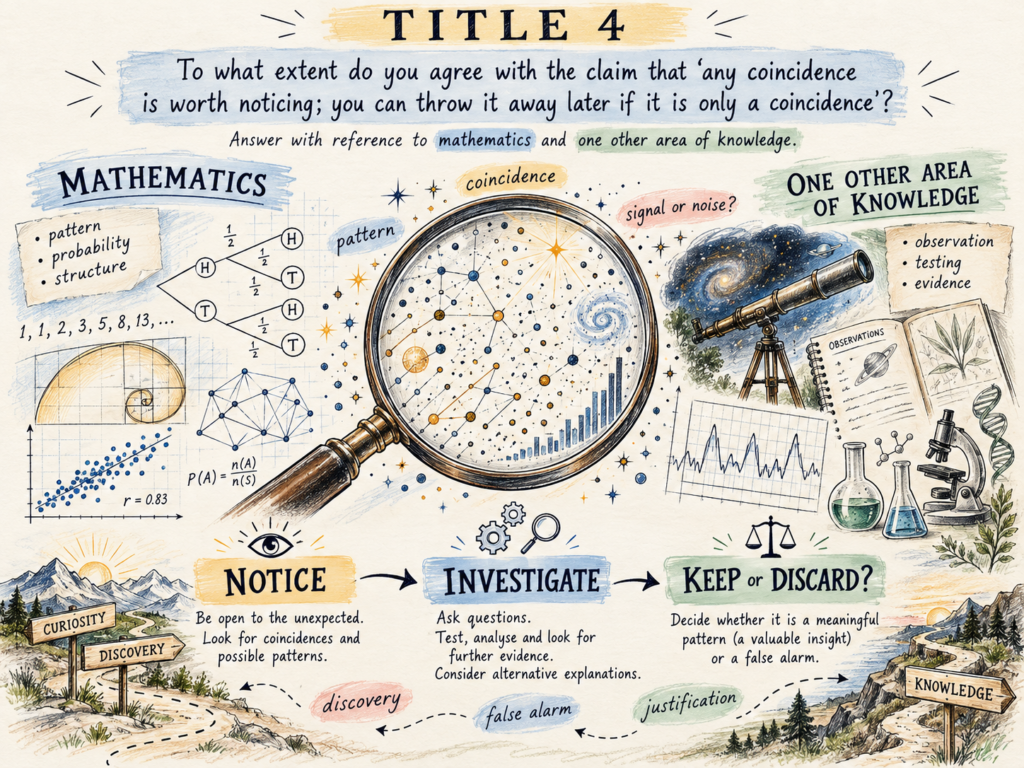
What is the Real Knowledge Problem?
Separate noticing from believing.
Christie’s statement proposes an epistemic sequence:
notice → investigate → discriminate → retain or discard.
The dangerous word is “any.”
Possible Hook
One of mathematics’ strangest modern discoveries began with the almost ridiculous observation that 196884 happens to equal 196883 + 1.
Thesis Direction
There is strong reason to value coincidence during discovery, because unexpected patterns can reveal relationships that existing theory did not predict. But agreement must weaken sharply at the stage of justification, because large information spaces inevitably generate patterns that carry no deeper significance.
AOK 1: Mathematics
Claim: A numerical coincidence can reveal an unsuspected structure connecting apparently unrelated areas of mathematics.
Use Monstrous Moonshine.
John McKay noticed that 196884 = 196883 + 1: a coefficient appearing in the modular jj-function sat astonishingly close to the dimension of the Monster group’s smallest non-trivial representation. Further numerical correspondences emerged, and what initially seemed absurd ultimately developed into the deep theory of Monstrous Moonshine; Richard Borcherds later proved major conjectures associated with it.
This is almost purpose-built for the Christie quotation.
Direction:
coincidence → conjecture → structural investigation → proof → knowledge.
The coincidence was not knowledge. It was an epistemic invitation.
Counterclaim: Mathematics itself shows that apparent patterns can be unavoidable and therefore epistemically unremarkable.
Use Ramsey theory.
R(3,3)=6R(3,3)=6 means that among any six people, if every pair is classified as acquaintances or strangers, there must necessarily be either three mutual acquaintances or three mutual strangers. Certain patterns therefore appear not because a hidden causal connection has been discovered but because sufficient combinatorial structure makes some pattern unavoidable.
That attacks “any coincidence.”
In a sufficiently large possibility space, the surprising event may actually be not finding a pattern.
Refined Mathematics Claim
Coincidence deserves attention in mathematics when it is unexpected relative to what the underlying structure already predicts.
AOK 2: Natural Sciences
Claim: Treating an anomaly as potentially meaningful can produce major discoveries.
Use Jocelyn Bell Burnell’s discovery of pulsars.
Bell noticed a tiny recurring “scruff” in enormous quantities of chart-recorder data. By November 1967 she identified highly regular pulses about 1.3 seconds apart; terrestrial interference was progressively ruled out, and the strange signal eventually became the first recognised pulsar.
The direction is not “she got lucky.”
It is:
anomaly noticed → ordinary explanations tested → recurrence established → alternative explanation constructed.
Observation becomes knowledge because curiosity is followed by methodological elimination.
Counterclaim: In enormous datasets, unusual-looking coincidences are statistically expected.
Use CERN’s 750 GeV diphoton excess. In 2015 ATLAS observed an excess around 750 GeV with a reported local significance reaching 3.9 sigma under one model. Physicists investigated intensely—but additional 2016 data did not confirm it, and ATLAS concluded it was consistent with an upward statistical fluctuation.
This gives a wonderful TOK distinction:
worth noticing ≠ worth believing.
Synthesis Direction
The quotation may therefore be strongest as a principle of epistemic curiosity, but far weaker as a principle for allocating belief or unlimited research attention. The student’s final degree of agreement should turn on the distinction between discovery thresholds and justification thresholds.
TOK concepts: Evidence, Certainty, Interpretation, Justification, Objectivity, Explanation.
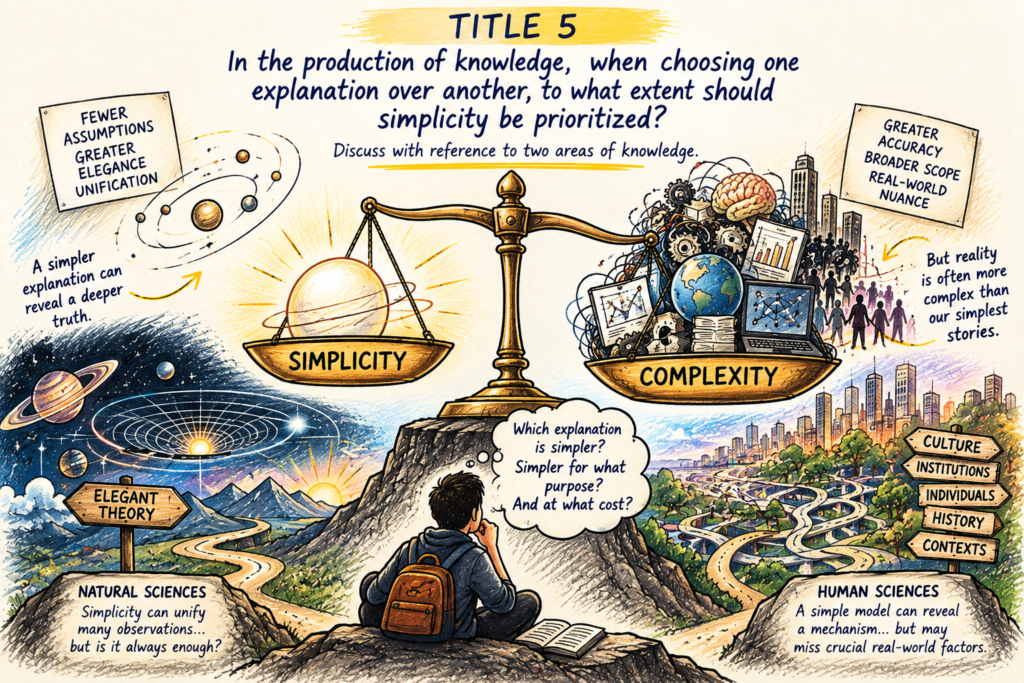
TOK Title 5: In the production of knowledge, when choosing one explanation over another, to what extent should simplicity be prioritized? Discuss with reference to two areas of knowledge.
What is the Real Knowledge Problem?
Do not let simplicity remain undefined.
It might mean:
fewer entities, fewer assumptions, fewer parameters, easier mathematics, explanatory unification or easier understanding.
Those forms of simplicity can point towards different explanations.
Possible Hook
The simplest explanation is attractive because it leaves unnecessary things out; it becomes dangerous when what it leaves out belongs to reality itself.
Thesis Direction
Simplicity deserves substantial priority when competing explanations possess comparable evidential adequacy and scope, particularly when simplicity reduces unnecessary assumptions. But it should remain subordinate to explanatory power and evidence when greater complexity reflects genuine structure in the phenomenon.
AOK 1: Natural Sciences
Claim: Simplicity can be epistemically valuable when it eliminates an ad hoc entity while explaining the anomaly through a more general principle.
Use Mercury, Vulcan and general relativity.
Nineteenth-century astronomers knew that Mercury’s perihelion advanced more than Newtonian calculations accounted for. One proposal added an unseen planet—Vulcan—inside Mercury’s orbit. It was never found. Einstein’s general relativity later accounted for the anomalous additional advance, approximately 43 arcseconds per century, without requiring the hypothetical planet.
But here is the TOK twist:
general relativity is mathematically more complex than “there is another planet.”
So which explanation is simpler?
The case forces students to distinguish mathematical simplicity from ontological simplicity and explanatory unification.
Counterclaim: Prioritising the apparently simpler theory can be misleading because simplicity changes with the scale of explanation.
Use the continuing MOND versus dark-matter problem.
Modified Newtonian Dynamics introduces a relatively simple modification at very low accelerations and has notable success with galaxy rotation phenomena. Yet critics point to difficulties at galaxy-cluster and cosmological scales, where dark-matter-based frameworks address a broader body of evidence.
The purpose is not to decide the astrophysics.
The TOK question is:
Should the explanation requiring fewer entities at one scale be preferred if another, more elaborate framework explains more phenomena across scales?
Refined Natural Sciences Claim
Simplicity should be prioritised only after specifying what is being simplified and what explanatory cost that simplification creates.
AOK 2: Human Sciences
Claim: Deliberately simple models can reveal causal mechanisms hidden inside social complexity.
Use Thomas Schelling’s segregation model.
Schelling demonstrated with a remarkably simple spatial model that relatively mild preferences about neighbours could generate strongly segregated macro-patterns, even without every individual possessing an extreme preference for segregation.
This is an outstanding simplicity example because the simplification is intentional.
The model does not attempt to recreate an entire city. Its epistemic purpose is to isolate one mechanism.
Direction:
simplification → isolation of mechanism → counterintuitive emergent pattern → explanatory insight.
Counterclaim: A simple mechanism can become epistemically dangerous when it migrates from “one possible mechanism” to “the explanation.”
Residential segregation did not emerge only from individual neighbourhood preferences. Research on twentieth-century US housing policy has identified long-term effects associated with government-backed discriminatory housing structures and redlining; studies link such policies to later segregation and disinvestment.
Now the argument becomes much sharper:
Schelling’s simplicity can reveal how segregation could emerge, while historical-institutional evidence may be necessary to explain why particular segregation actually emerged where and when it did.
Synthesis Direction
Simplicity may be a powerful instrument for isolating mechanisms, but a poor substitute for reality when the purpose changes from modelling possibility to explaining actual causation.
The final judgement should therefore ask not simply “Is the simpler explanation better?” but “Simpler for what epistemic purpose?”
TOK concepts: Explanation, Evidence, Justification, Objectivity, Interpretation, Truth.
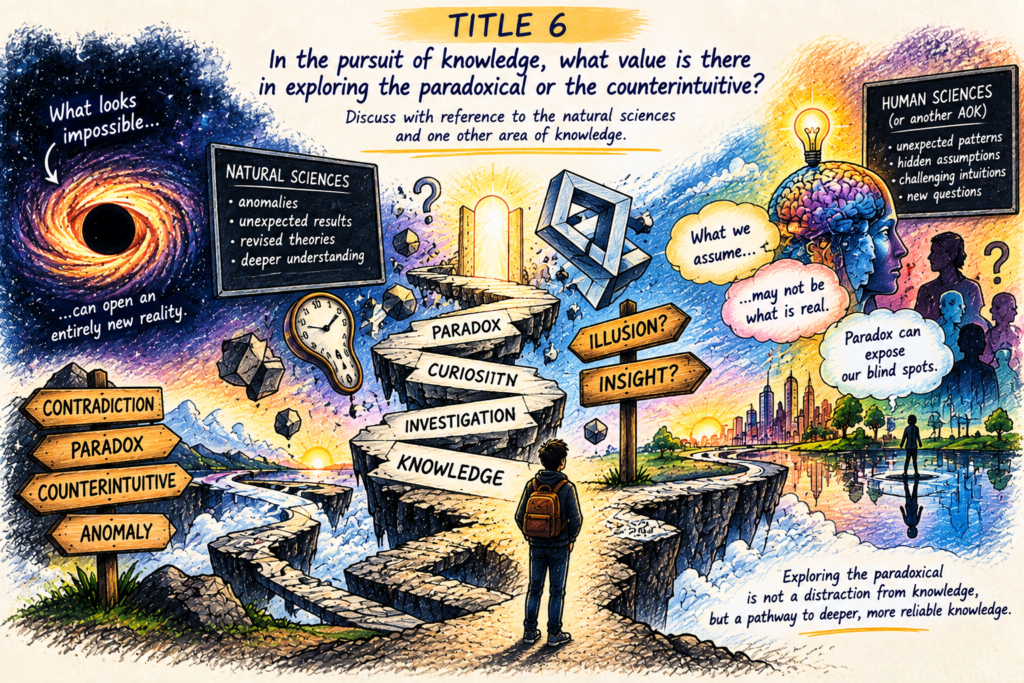
TOK Title 6: In the pursuit of knowledge, what value is there in exploring the paradoxical or the counterintuitive? Discuss with reference to the natural sciences and one other area of knowledge.
What is the Real Knowledge Problem?
The title does not ask whether paradoxes are interesting. It asks what they contribute to the pursuit of knowledge.
The learner therefore needs criteria for epistemic value:
Does the anomaly reveal a hidden assumption? Generate a new theory? Improve a method? Expose bad measurement? Force finer distinctions?
Possible Hook
Sometimes the most valuable observation is the one that should not exist if everything we currently believe is correct.
Thesis Direction
The paradoxical and counterintuitive become epistemically valuable when they create a productive mismatch between expectation and evidence, forcing knowers to test the assumptions that made the result appear impossible. Their value lies not necessarily in proving the anomaly true, but in what investigating it reveals about existing knowledge.
AOK 1: Natural Sciences
Claim: Persistent counterintuitive evidence can reveal that a foundational theory is incomplete.
Use the solar neutrino problem.
Raymond Davis’s experiment detected only around one-third of the solar neutrinos predicted. For decades researchers tested the solar models, detectors and theoretical assumptions. The eventual explanation—neutrino oscillation between different “flavours”—showed that the missing neutrinos were not actually missing and required a revision in particle physics.
This is a superb direction because the anomaly could have meant:
bad theory → bad measurement → or unknown phenomenon.
Exploration created value by forcing those possibilities to compete.
Activate certainty, evidence, explanation and falsifiability.
Counterclaim: A counterintuitive finding may reveal nothing revolutionary about reality.
Use the OPERA faster-than-light neutrino anomaly.
In 2011 OPERA reported a surprising neutrino time-of-flight result apparently inconsistent with the speed-of-light limit. Further scrutiny and comparison across experiments eventually traced the anomaly to problems in the timing system, including a faulty fibre-optic element; later measurements were consistent with light speed.
But do not finish with:
“So the anomaly had no value.”
That would miss the title.
Its exploration demonstrated the value of replication, instrumental scrutiny and collaborative criticism. A paradox can advance knowledge even when the paradox itself disappears.
Refined Natural Sciences Claim
The epistemic value of the counterintuitive lies less in being true than in its capacity to impose a severe test on what researchers think they already know.
AOK 2: Human Sciences
Claim: Counterintuitive patterns can expose the danger of intuitive interpretation of data.
Use the 1973 UC Berkeley graduate-admissions data, now a classic illustration of Simpson’s paradox.
Aggregated figures appeared to show substantially lower admission rates for female applicants. Yet once results were examined by department, the pattern changed: women had disproportionately applied to more competitive departments, and the simple aggregate inference became misleading.
The TOK value is enormous.
The paradox forces the knower to ask:
At what level should evidence be aggregated? Which variable is confounding the apparent relationship? Can the same dataset support opposite-looking interpretations?
Thus, exploring a paradox can improve causal reasoning, not merely statistical technique.
Counterclaim: The intellectual glamour of the counterintuitive can give weak findings disproportionate attention.
Use Daryl Bem’s 2011 precognition experiments.
Bem published experimental results interpreted as evidence that later events could influence earlier performance—a deeply counterintuitive proposition. Three preregistered independent replications involving 150 participants failed to reproduce one central effect, producing a combined one-tailed p=.83p=.83.
The sophisticated argument is not simply:
Bem was wrong.
Instead ask:
Should highly counterintuitive claims require stronger evidential thresholds before scarce epistemic attention is invested in them?
And then push once more: even failed claims can have meta-epistemic value if investigating them exposes weaknesses in statistical practice and strengthens replication norms.
Synthesis Direction
This title can produce a particularly strong conclusion:
the paradoxical is valuable not because knowledge should celebrate strangeness, but because contradiction places pressure on the assumptions, methods and inferential habits that ordinary results leave undisturbed.
The final judgement can then distinguish three possible outcomes:
a paradox that changes the theory, an anomaly that corrects the method, or a surprising claim that is discarded but strengthens the standards by which future claims are judged.
TOK concepts: Evidence, Certainty, Explanation, Interpretation, Justification, Objectivity and Truth.
What Students Should Notice Across All Six Titles
The real lesson is that a TOK example must never function as a decorative case study.
Evidence should do something to the argument.
Salcedo should force a distinction between experiencing and reconstructing. The Havasupai case should destabilise the idea that there is one timeless set of values guiding science. Synthetic California should make students confront the fact that causal knowledge can depend upon an unobservable counterfactual. Monstrous Moonshine should separate noticing a pattern from justifying it. Schelling should expose the difference between a simple model that isolates a mechanism and a complete explanation of reality. The solar-neutrino problem should show why an anomaly can be epistemically productive even before anyone knows whether the failure belongs to the theory, the instrument or nature.
That is the standard to apply to every real-world example:
Do not ask, “Does this example fit my claim?”
Ask:
“What does this evidence force my claim to become?”
That is where the TOK movement occurs:
Claim → Evidence → Analysis → Counterclaim → Counter-evidence → Evaluation → Response → Refined Claim → Link to Thesis.
Then the second AOK must perform the same intellectual cycle, rather than merely supplying another example.
Only after both AOKs have survived that pressure should the essay move towards:
Synthesis → Reinforced Thesis → Qualified Final Judgement → Implication.